On most mornings, I am already behind.
The light filters in through the window curtain like a tired sigh. My phone, though untouched, vibrates with the insistence of a hundred conversations I did not sign up for. Emails blink like Morse code from another battlefield, WhatsApp pings echo with urgency, and I am expected—by the world, by the clock, by a restless algorithm—to respond.
But somewhere between that first flicker of guilt and the second cup of tea, I remember a phrase: Work deeply.
Not harder. Not faster. Just—deeper.
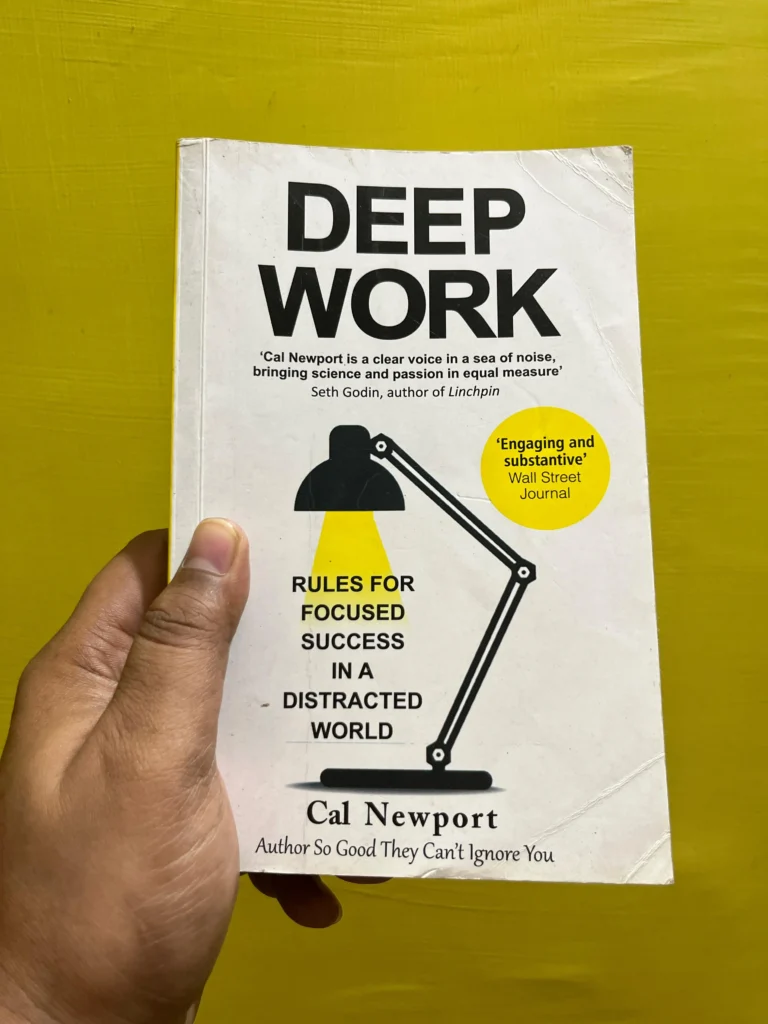
It was Cal Newport who first whispered this gospel to the distracted faithful. In his book Deep Work: Rules for Focused Success in a Distracted World, Newport doesn’t merely propose a productivity hack. He offers a quiet rebellion. A return to monastic clarity in an age of digital cacophony.
And it begins with four hours. Four sacred, uninterrupted hours.
I. The Value Equation: Attention x Time = Meaning
In a world that equates activity with accomplishment, Newport’s central thesis is counterintuitive: focus is rare, and therefore focus is valuable. He backs this with a blend of historical insight and hard data.
A McKinsey study found that high-performing workers spend over 60% of their work week communicating via email or meetings—tasks Newport classifies as “shallow work.” In contrast, deep work—cognitive efforts that create new value and stretch one’s abilities—occupies barely 15–20% of a professional’s day, if at all.
Newport calls deep work a “superpower” for the modern knowledge worker. It’s the same edge that helped Carl Jung retreat into his stone tower to build a new architecture of the mind, or Bill Gates to schedule his now-mythic “Think Weeks.”
Four hours of undistracted focus, Newport suggests, is the golden number. Do this consistently, and you begin to change not just your output, but your identity.
II. The Case for Concentration in a World That Celebrates Fragmentation
The modern internet economy is built on distraction. Newport reminds us that social media platforms are not neutral tools; they are billion-dollar attention traps. A study by Gloria Mark at the University of California Irvine revealed that the average worker is interrupted every 11 minutes and takes 23 minutes to return to the original task.
The result? A cognitive shallowness. A thinning of thought.
But Newport argues that depth is where the magic lies. Not just the productivity magic, but the poetic one too—the kind that lets a writer enter the fugue state, or a programmer disappear into code, or a teacher truly see a student.
III. The Four Rules: A Ritual Against the World’s Noise
Newport structures his book around four deceptively simple but profound rules. Each one is a discipline in its own right, a small revolution.
Rule 1: Work Deeply
Create rituals. Build fortresses of solitude.
Newport describes this as establishing “grand gestures.” J.K. Rowling checking into the Balmoral Hotel to finish The Deathly Hallows. Peter Higgs, of Higgs Boson fame, choosing to remain unreachable for decades. The point is not withdrawal for its own sake, but withdrawal with intent.
To live like this, one must resist the culture of availability. One must say no.
Rule 2: Embrace Boredom
We have forgotten how to be bored.
Newport proposes boredom as a training ground for focus. Don’t reach for your phone at every red light. Don’t fill every moment. Let the silence stretch. Let your brain ache a little.
He introduces the idea of productive meditation: use mentally undemanding tasks—walking, showering, waiting—as opportunities to work through a problem with full attention.
Rule 3: Quit Social Media
Radical? Perhaps. Necessary? Absolutely.
Rather than taking a Luddite view, Newport urges intentionality. Run the Craftsman Test: does this tool bring substantial positive value with minimal negative cost? If not, quit.
One study found that quitting Facebook for just a week led to a 55% reduction in cortisol levels. Another revealed that smartphone users unlock their phones over 80 times a day. Focus, Newport insists, begins with subtraction.
Rule 4: Drain the Shallows
Shallow work is like sugar—easy, addictive, and ultimately hollow. Newport recommends:
• Scheduling every minute of your workday.
• Saying “no” with surgical precision.
• Ending each day with a shutdown ritual that signals the brain: we are done.
He is not against shallow work entirely. Rather, he argues that we must contain it—allocate time to it like we do to errands, lest it flood the creative plains of our day.
IV. Monks of the Mind: Choosing Your Deep Work Philosophy
Newport outlines four philosophies of deep work:
1. Monastic: Like the mathematician Grigori Perelman—who disappeared from the world to solve the Poincaré Conjecture—this approach requires near-total withdrawal.
2. Bimodal: Divide your time between deep, isolated stretches and shallow, collaborative ones.
3. Rhythmic: Schedule deep work daily at fixed hours (the most feasible for most professionals).
4. Journalistic: Drop into deep work whenever possible—requires elite mental agility.
I have tried all four. Failed at three. Found rhythm in the fourth.
V. The Architecture of Attention: Building a Life Around Depth
Newport’s argument is not just about better time management. It is about reclaiming one’s soul from the tyranny of noise.
He borrows from the psychology of deliberate practice, the neuroscience of attention, and the philosophy of craftsmanship. He reminds us that people who produce at an elite level don’t just work more. They work differently.
A violinist in Berlin’s elite conservatory spends over 25 hours a week in focused practice—twice as much as average students. A coder at Google who shuts the door for two hours may write a cleaner algorithm than someone who toils distractedly for eight.
The correlation is clear: input time is not linear to output value. Depth compounds. Like interest. Like love.
VI. A Ritual, a Room, and a Refusal
In a quiet corner of my study, I’ve made a pact.
Each morning, I light a stick of incense, place my phone in a drawer, and open the same notebook. This is not superstition. It is ritual. It is defiance.
In a world that asks us to be everywhere, all the time, Deep Work teaches us to be somewhere—fully.
It is not easy. But it is worth it.
Conclusion: Stillness is the Sharpest Blade
Cal Newport’s Deep Work is not just a book. It is a blueprint for reclaiming your cognitive life.
It asks you to choose excellence over ease, presence over performance, and creation over consumption.
In a world built to keep you scrolling, Deep Work asks: what if you stopped?
What if four hours of silence could change everything?